> ## Documentation Index
> Fetch the complete documentation index at: https://docs.inferless.com/llms.txt
> Use this file to discover all available pages before exploring further.
# Deploy Llama-3.1-8B-Instruct GGUF using Inferless
> Llama-3.1-8B-Instruct GGUF is a quantized version of Meta's state-of-the-art Llama-3.1 series of large language models. This guide will take you through the deployment process of the GGUF model on the Inferless platform.
## Introduction
[Llama-3.1-8B-Instruct GGUF](https://huggingface.co/bartowski/Meta-Llama-3.1-8B-Instruct-GGUF) is a quantized version of Meta's advanced multilingual large language model. The GGUF (GPT-Generated Unified Format) format allows for efficient, including lower-end GPUs.
This 8B Instruct model has been fine-tuned using supervised fine-tuning (SFT) and reinforced through reinforcement learning with human feedback (RLHF). The GGUF version maintains high accuracy while significantly reducing the model size and improving inference speed.
## Our Observations
We have deployed the model on an A100 GPU(80GB). Here are our observations:
| Library | Inference Time | Cold Start Time | Tokens/Sec | Output Tokens Length |
| ---------------- | -------------- | --------------- | ---------- | -------------------- |
| llama-cpp-python | 2.46 sec | 3.363 | 104.25 | 256 |
Note: The inference time, cold start time, and tokens per second are average values.
## Defining Dependencies
We are using the [llama-cpp-python](https://github.com/abetlen/llama-cpp-python) to serve the GGUF quantized model on a single A100 (80GB).
## Constructing the GitHub/GitLab Template
Now quickly construct the GitHub/GitLab template, this process is mandatory and make sure you don't add any file named `model.py`.
```
Llama-3.1-8B-Instruct-GGUF/
├── app.py
├── inferless-runtime-config.yaml
├── inferless.yaml
└── input_schema.py
```
You can also add other files to this directory.
## Create the class for inference
In the [app.py](https://github.com/inferless/Llama-3.1-8B-Instruct-GGUF/blob/main/app.py) we will define the class and import all the required functions
1. `def initialize`: In this function, you will initialize your model and define any `variable` that you want to use during inference.
2. `def infer`: This function gets called for every request that you send. Here you can define all the steps that are required for the inference. You can also pass custom values for inference and pass it through `inputs(dict)` parameter.
3. `def finalize`: This function cleans up all the allocated memory.
```python theme={null}
from llama_cpp import Llama
from huggingface_hub import hf_hub_download
import os
import inferless
app = inferless.Cls(gpu="A100")
class InferlessPythonModel:
@app.load
def initialize(self):
nfs_volume = os.getenv("NFS_VOLUME","./models")
if os.path.exists(nfs_volume + "/Meta-Llama-3.1-8B-Instruct-Q8_0.gguf") == False :
cache_file = hf_hub_download(
repo_id="bartowski/Meta-Llama-3.1-8B-Instruct-GGUF",
filename="Meta-Llama-3.1-8B-Instruct-Q8_0.gguf",
local_dir=nfs_volume)
self.llm = Llama(
model_path=f"{nfs_volume}/Meta-Llama-3.1-8B-Instruct-Q8_0.gguf",
main_gpu=0,
n_gpu_layers=-1)
@app.infer
def infer(self, inputs):
prompt = inputs["prompt"]
system_prompt = inputs.get("system_prompt","You are a friendly bot.")
temperature = inputs.get("temperature",0.7)
top_p = inputs.get("top_p",0.1)
top_k = inputs.get("top_k",40)
repeat_penalty = inputs.get("repeat_penalty",1.18)
max_tokens = inputs.get("max_tokens",256)
output = self.llm.create_chat_completion(
messages = [
{"role": "system", "content": f"{system_prompt}"},
{"role": "user","content": f"{prompt}"}],
temperature=temperature, top_p=top_p, top_k=top_k,repeat_penalty=repeat_penalty,max_tokens=max_tokens
)
text_result = output['choices'][0]['message']['content']
return {'generated_result': text_result}
def finalize(self):
self.llm = None
```
## Create the Input Schema
We have to create a [input\_schema.py](https://github.com/inferless/Llama-3.1-8B-Instruct-GGUF/blob/main/input_schema.py) in your GitHub/Gitlab repository this will help us create the Input parameters. You can checkout our documentation on [Input / Output Schema](https://docs.inferless.com/model-import/input-output-schema).
For this tutorial, we have defined these parameter `prompt`, `temperature`, `top_p`, `repeat_penalty`, `max_tokens` and `top_k` which are required during the API call. Now lets create the `input_schema.py`.
```JSON theme={null}
INPUT_SCHEMA = {
"prompt": {
'datatype': 'STRING',
'required': True,
'shape': [1],
'example': ["What is deep learning?"]
},
"system_prompt": {
'datatype': 'STRING',
'required': False,
'shape': [1],
'example': ["You are a friendly bot."]
},
"temperature": {
'datatype': 'FP32',
'required': False,
'shape': [1],
'example': [0.7]
},
"top_p": {
'datatype': 'FP32',
'required': False,
'shape': [1],
'example': [0.1]
},
"repeat_penalty": {
'datatype': 'FP32',
'required': False,
'shape': [1],
'example': [1.18]
},
"max_tokens": {
'datatype': 'INT16',
'required': False,
'shape': [1],
'example': [512]
},
"top_k":{
'datatype': 'INT8',
'required': False,
'shape': [1],
'example': [40]
}
}
```
## Creating the Custom Runtime
This is a mandatory step where we allow the users to upload their custom runtime through [inferless-runtime-config.yaml](https://github.com/inferless/Llama-3.1-8B-Instruct-GGUF/blob/main/inferless-runtime-config.yaml).
```python theme={null}
build:
cuda_version: "12.1.1"
python_packages:
- inferless-cli==2.0.9
- hf-transfer==0.1.9
- huggingface-hub==0.27.1
- llama-cpp-python==0.3.7
```
## Test your model with Remote Run
You can use the `inferless remote-run`([installation guide here](https://docs.inferless.com/model-import/cli-import#cli-import)) command to test your model or any custom Python script in a remote GPU environment directly from your local machine. Make sure that you use `Python3.10` for seamless experience.
### Step 1: Add the Decorators and local entry point
To enable **Remote Run**, simply do the following:
1. Import the `inferless` library and initialize `Cls(gpu="A100")`. The available GPU options are `T4`, `A10` and `A100`.
2. Decorated the `initialize` and `infer` functions with `@app.load` and `@app.infer` respectively.
3. Create the Local Entry Point by decorating a function (for example, `my_local_entry`) with `@inferless.local_entry_point`.
Within this function, instantiate your model class, convert any incoming parameters into a `RequestObjects` object, and invoke the model's `infer` method.
```python theme={null}
from llama_cpp import Llama
from huggingface_hub import hf_hub_download
import os
import inferless
from pydantic import BaseModel, Field
from typing import Optional
app = inferless.Cls(gpu="A100")
@inferless.request
class RequestObjects(BaseModel):
prompt: str = Field(default="Explain Deep Learning.")
system_prompt: Optional[str] = "You are a friendly bot."
temperature: Optional[float] = 0.7
top_p: Optional[float] = 0.1
repeat_penalty: Optional[float] = 1.18
top_k: Optional[int] = 40
max_tokens: Optional[int] = 256
@inferless.response
class ResponseObjects(BaseModel):
generated_text: str = Field(default='Test output')
class InferlessPythonModel:
@app.load
def initialize(self):
nfs_volume = os.getenv("NFS_VOLUME","./models")
if os.path.exists(nfs_volume + "/Meta-Llama-3.1-8B-Instruct-Q8_0.gguf") == False :
cache_file = hf_hub_download(
repo_id="bartowski/Meta-Llama-3.1-8B-Instruct-GGUF",
filename="Meta-Llama-3.1-8B-Instruct-Q8_0.gguf",
local_dir=nfs_volume)
self.llm = Llama(
model_path=f"{nfs_volume}/Meta-Llama-3.1-8B-Instruct-Q8_0.gguf",
main_gpu=0,
n_gpu_layers=-1)
@app.infer
def infer(self, request: RequestObjects) -> ResponseObjects:
output = self.llm.create_chat_completion(
messages = [
{"role": "system", "content": f"{request.system_prompt}"},
{"role": "user","content": f"{request.prompt}"}],
temperature=request.temperature, top_p=request.top_p, top_k=request.top_k,
repeat_penalty=request.repeat_penalty,max_tokens=request.max_tokens
)
text_result = output['choices'][0]['message']['content']
generateObject = ResponseObjects(generated_text = text_result)
return generateObject
def finalize(self):
self.llm = None
@inferless.local_entry_point
def my_local_entry(dynamic_params):
request_objects = RequestObjects(**dynamic_params)
model_instance = InferlessPythonModel()
return model_instance.infer(request_objects)
```
### Step 2: Run with Remote GPU
From your local terminal, navigate to the folder containing your `app.py` and your `inferless-runtime-config.yaml` and run:
```bash theme={null}
inferless remote-run app.py -c inferless-runtime-config.yaml --prompt "What is deep learning?"
```
You can pass the other input parameters in the same way (e.g., `--system_prompt`, `--temperature`, etc.) as long as your code expects them in the `inputs` dictionary.
If you want to exclude certain files or directories from being uploaded, use the `--exclude` or `-e` flag.
## Method A: Deploying the model on Inferless Platform
Inferless supports multiple ways of [importing your model](https://docs.inferless.com/model-import/file-structure-req/file-structure-requirements). For this tutorial, we will use GitHub.
### Step 1: Login to the inferless dashboard can click on Import model button
Navigate to your desired workspace in Inferless and Click on `Add a custom model` button that you see on the top right. An import wizard will open up.
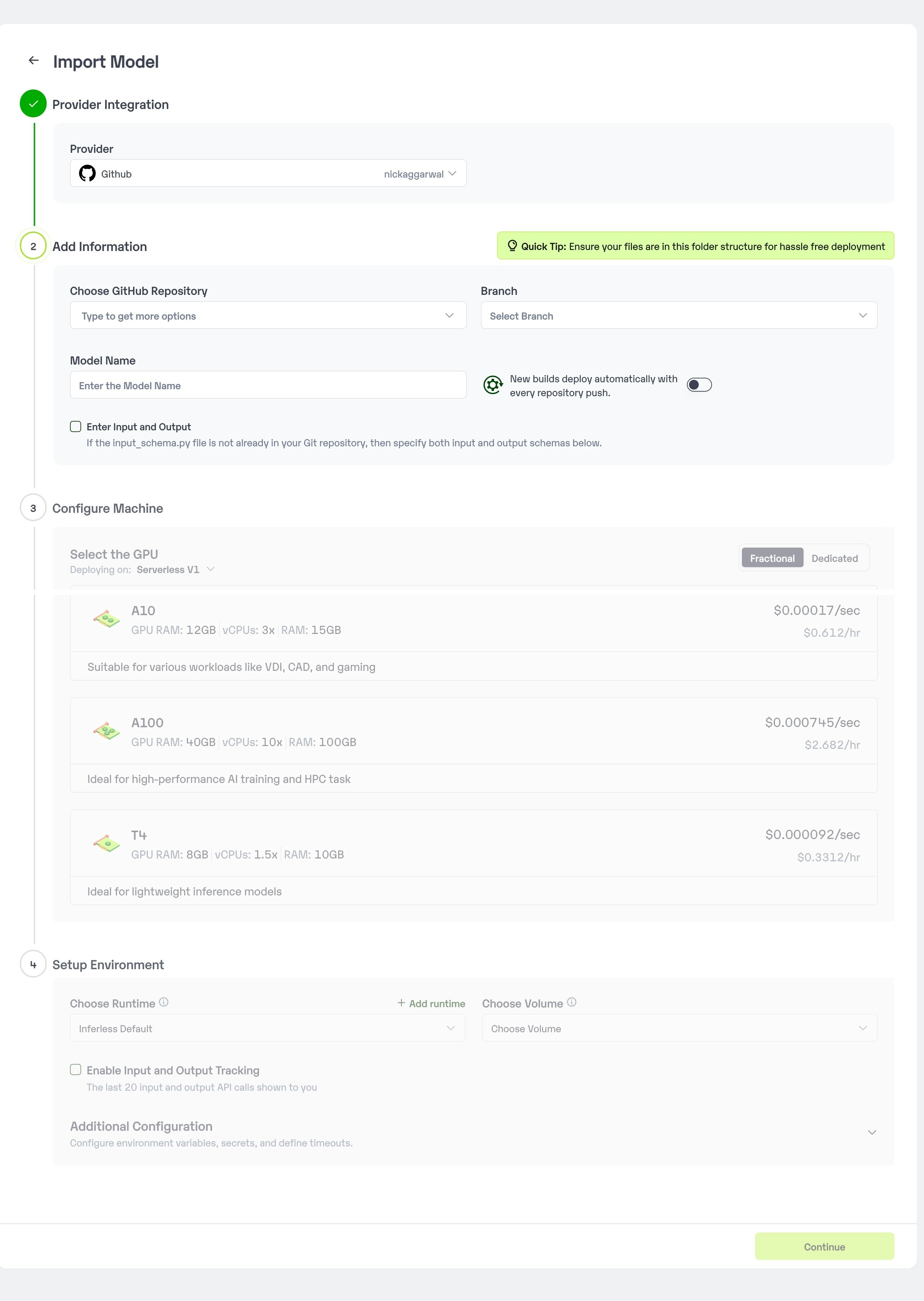
### Step 2: Follow the UI to complete the model Import
* Select the GitHub/GitLab Integration option to connect your source code repository with the deployment environment.
* Navigate to the specific GitHub repository that contains your model's code. Here, you will need to identify and enter the name of the model you wish to import.
* Choose the appropriate type of machine that suits your model's requirements. Additionally, specify the minimum and maximum number of replicas to define the scalability range for deploying your model.
* Optionally, you have the option to enable automatic build and deployment. This feature triggers a new deployment automatically whenever there is a new code push to your repository.
* If your model requires additional software packages, configure the Custom Runtime settings by including necessary pip or apt packages. Also, set up environment variables such as Inference Timeout, Container Concurrency, and Scale Down Timeout to tailor the runtime environment according to your needs.
* Wait for the validation process to complete, ensuring that all settings are correct and functional. Once validation is successful, click on the "Import" button to finalize the import of your model.
 ### Step 3: Wait for the model build to complete usually takes \~5-10 minutes
### Step 4: Use the APIs to call the model
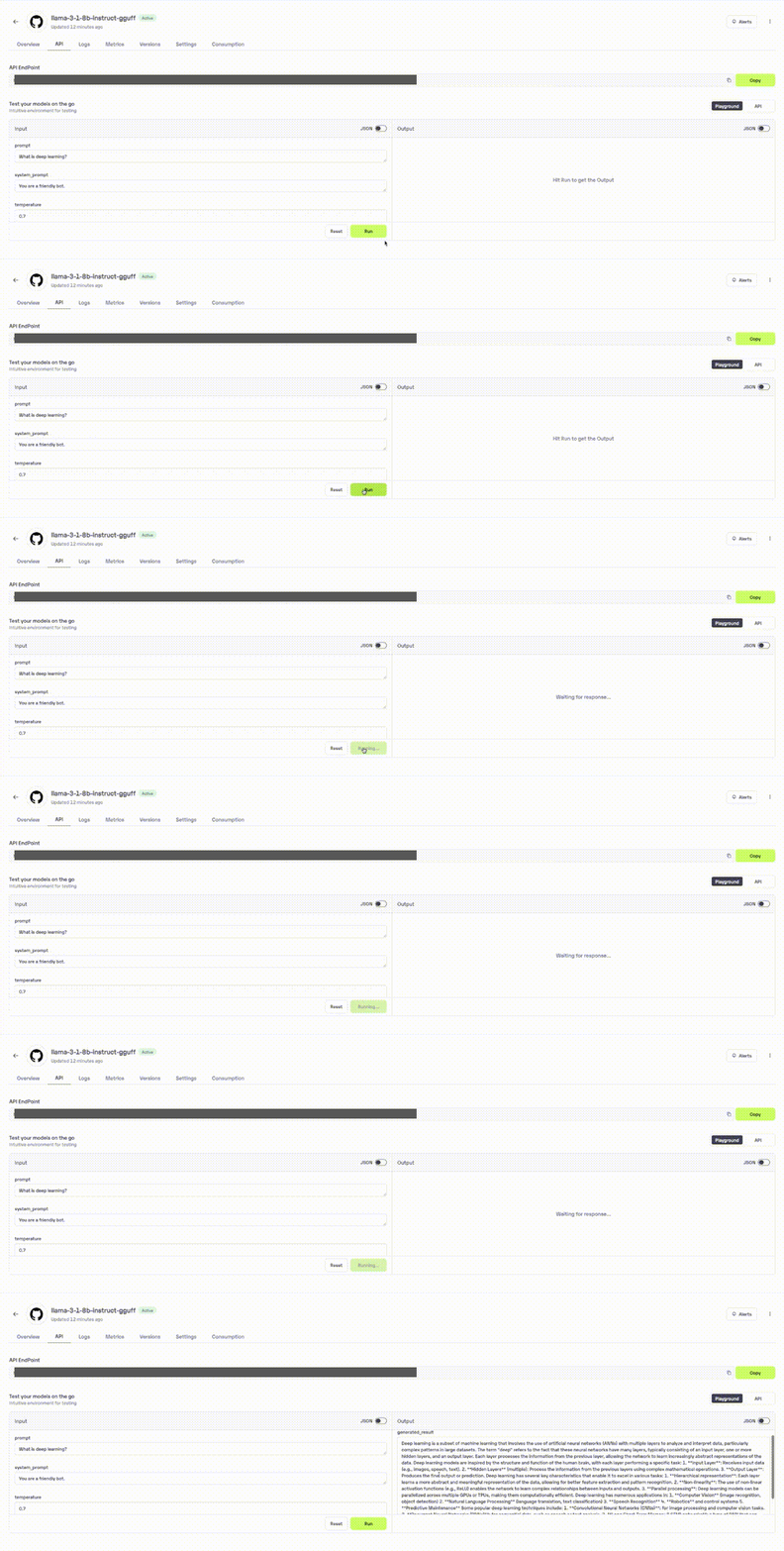
Once the model is in 'Active' status you can click on the 'API' page to call the model
### Here is the Demo:
### Step 3: Wait for the model build to complete usually takes \~5-10 minutes
### Step 4: Use the APIs to call the model
Once the model is in 'Active' status you can click on the 'API' page to call the model
### Here is the Demo:
 ## Method B: Deploying the model on Inferless CLI
Inferless allows you to deploy your model using Inferless-CLI. Follow the steps to deploy using Inferless CLI.
### Clone the repository of the model
Let's begin by cloning the model repository:
```bash theme={null}
git clone https://github.com/inferless/Llama-3.1-8B-Instruct-GGUF.git
```
### Deploy the Model
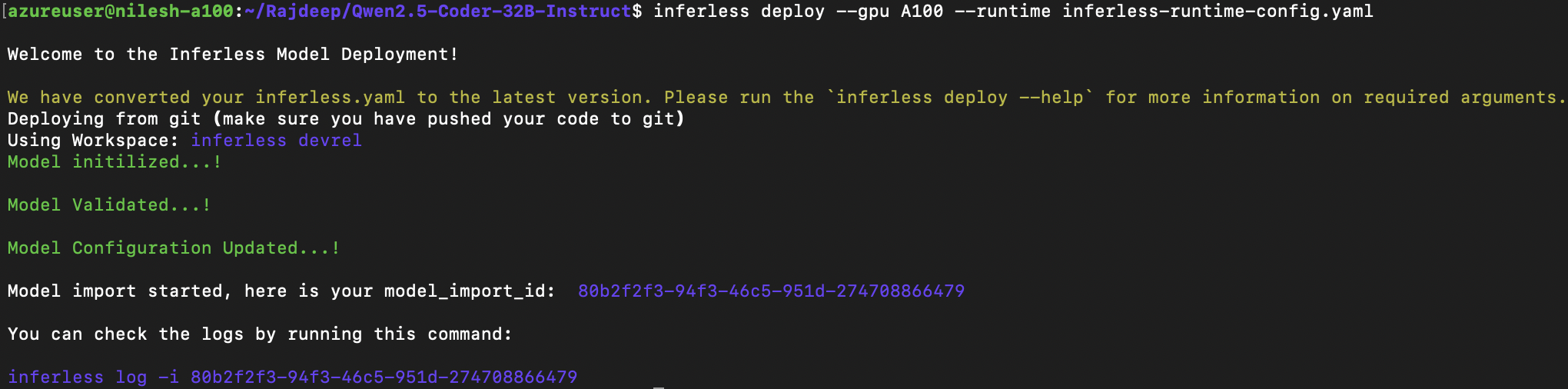
To deploy the model using Inferless CLI, execute the following command:
```bash theme={null}
inferless deploy --gpu A100 --runtime inferless-runtime-config.yaml
```
**Explanation of the Command:**
* `--gpu A100`: Specifies the GPU type for deployment. Available options include `A10`, `A100`, and `T4`.
* `--runtime inferless-runtime-config.yaml`: Defines the runtime configuration file. If not specified, the default Inferless runtime is used.
## Method B: Deploying the model on Inferless CLI
Inferless allows you to deploy your model using Inferless-CLI. Follow the steps to deploy using Inferless CLI.
### Clone the repository of the model
Let's begin by cloning the model repository:
```bash theme={null}
git clone https://github.com/inferless/Llama-3.1-8B-Instruct-GGUF.git
```
### Deploy the Model
To deploy the model using Inferless CLI, execute the following command:
```bash theme={null}
inferless deploy --gpu A100 --runtime inferless-runtime-config.yaml
```
**Explanation of the Command:**
* `--gpu A100`: Specifies the GPU type for deployment. Available options include `A10`, `A100`, and `T4`.
* `--runtime inferless-runtime-config.yaml`: Defines the runtime configuration file. If not specified, the default Inferless runtime is used.